- Generated by
 1.15.0
|
myl7/fss 2.0.0
Function secret sharing (FSS) primitives including distributed point/comparison function (DPF/DCF)
|
The current FSS curves measure v2.0.0. Their raw results retain the earlier build label 1.3.0-unreleased, which identifies the same development collection, not the released v1.3.0 API.
Use third_party/figure_bench.py to reproduce the time curves. Run from the repository root on Linux after following the pinned dependency and toolchain setup. CPU curves use cs659b: AMD EPYC 9115, NVIDIA RTX PRO 5000, SM 120, and CUDA 13.2. The current collection, taken on 2026-11-08 UTC (2026-11-09 HKT) for v2.0.0, pins CPU operations to CPU 25 (sibling 57, NUMA node 1) with one CPU thread and the performance governor; the historical third-party rows below were collected pinned to CPU 24 with the same governor, so cross-collection comparisons are not strictly placed on the same core. GPU curves use cs11369a: Intel Xeon Platinum 8352V, NVIDIA A6000, SM 86, and CUDA 12.6. The native GPU run and the domain Gen / EvalAll collections launch from CPU 100; the point-Eval supplement and the block sweep, including its scheme-isolated T=1024 supplements, launch from CPU 30 (sibling 102, NUMA node 0, schedutil governor as found on the shared host), all against the admitted idle GPU GPU-f976dcde-dac4-5451-626e-908adcf0ccb2; the earlier v1.3.0 repair recollection of 2026-10-18 used CPU 100 and GPU 3. Retained third-party receipts identify their original device and run configuration. All four devices on this host are the same A6000 model. Historical FSS 0.7 has no GPU curves: its upstream benchmarks crash on the A6000 with a misaligned address, so the merge drops its GPU rows instead of keeping measurements from the previous GPU. The run manifest records the actual hardware, toolchain versions, affinity arguments, and governor.
The domain sweep uses N = 2^n, with n = 8, 10, 12, 14, 16, 18, 20. CPU libfss and GPU-DPF materialized point-loop EvalAll cases use n = 8, 12, 14, 18, 20 because each iteration calls point Eval at all N inputs. The other supported cases use seven domain sizes. The separate current-FSS block sweep fixes n = 20 and uses T = 16, 32, 64, 128, 256, 512, 1024 threads per block.
CPU Gen times one direct public Core Gen call per iteration, one attempt on fixture material that already succeeded in setup; the seed-retry loop and the second-party fixture copy stay outside the timed region. CPU Eval measures one party at one query. EvalAll measures one party over N logical domain outputs with one key. Ordinary GPU Gen and point Eval use 262144 independent keys per invocation. GPU DMPF/VDMPF Eval uses one key and 262144 queries. Their key count is 1, their query count is 262144, and their point time is ns/query. Full-domain GPU evaluation uses one key. Domain runs request T=256 for point operations and T=128 for full evaluation where configurable. EzPC and the multi-point kernels use fixed T=256. A packed frontier may use fewer threads than requested for a small domain.
The collector checks native domain, launch, and explicit work-count counters against the requested case before accepting a receipt, and every raw repetition of one benchmark must report the same per-iteration work counters, including the proof, prepared-leaf, and point-hash fields. Point-hash bytes are raw corrected hash material, preserved separately from logical outputs and proofs. The supported-case registry controls both default and scoped GPU filters. Only the DPF software-AES point workload is in the block sweep. A scoped block sweep for a different scheme skips point Eval instead of selecting that DPF workload.
Records preserve raw elapsed median_ns and time_ns. The explicit fields key_count, query_count, and domain_output_count state the work per timed invocation. Gen, Prepare, and EvalAll use time_denominator="key". Eval uses time_denominator="query". ns_per_unit divides raw elapsed time by that count. ns_per_domain_output divides full-domain elapsed time by the logical output count, including when outputs are packed. These rates do not count packed storage words as domain outputs. workload distinguishes independent keys from a single-key query batch. setup_included and timing_boundary state what the timed operation contains.
num_keys and ns_per_key remain historical export fields. Their original values are also recorded in legacy_quantity_fields. They mislabeled old multi-query batches and must not be used for new normalization. Receipt counters take priority over requested T, which is retained as requested_threads_per_block. Old multi-point receipts without counters keep the legacy wrapper contract (one key, kN queries, fixed T=256) only when the row itself recorded it as quantity_source="verified_wrapper_source" at collection time; the contract never changes the elapsed measurements and is never re-derived from the local source tree. Unknown wrapper/counter combinations are marked metadata_status="requires_recollection" and omitted from figures. This metadata repair does not represent a new measurement.
The mastic, plasma, dpf-cpp, and dpfplusplus additions join the CPU sweep with their own availability windows. mastic covers Gen at n = 12, 16, 20, Eval at n = 16, and EvalAll at n = 12, 16, 20; its EvalAll rows time both parties' eval_tree including the BLAKE3 proof digest comparison, and its outputs are Field128 shares. plasma covers Gen at n = 16, 20 and Eval at n = 16 with the running proof chained into the timing; upstream has no full-domain API. dpf-cpp and dpfplusplus cover Gen and Eval at n = 16, 20 and EvalAll at n = 16, 18, 20 with bit-valued outputs (a packed-bit truth table and 128-lane packed nodes respectively); dpf-cpp's Gen draws from a fixed-seed test PRG. sycret does not join the domain sweeps: its EQ and CMP batched operations are reported by bench.py only, counted per key or point over its fixed 32-bit domain. dpfplusplus sources are fetched and patched at bench time because the upstream license forbids redistribution (bench-dpfplusplus.md).
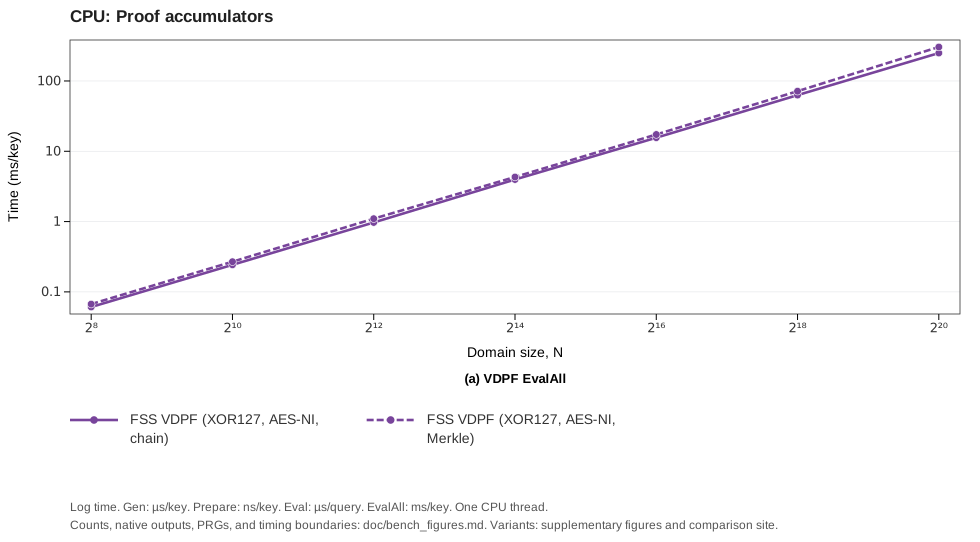
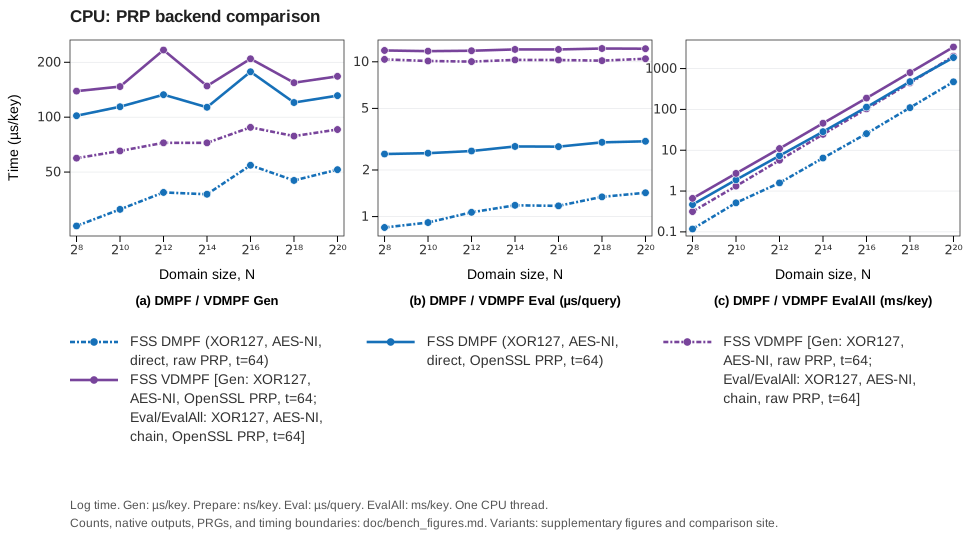
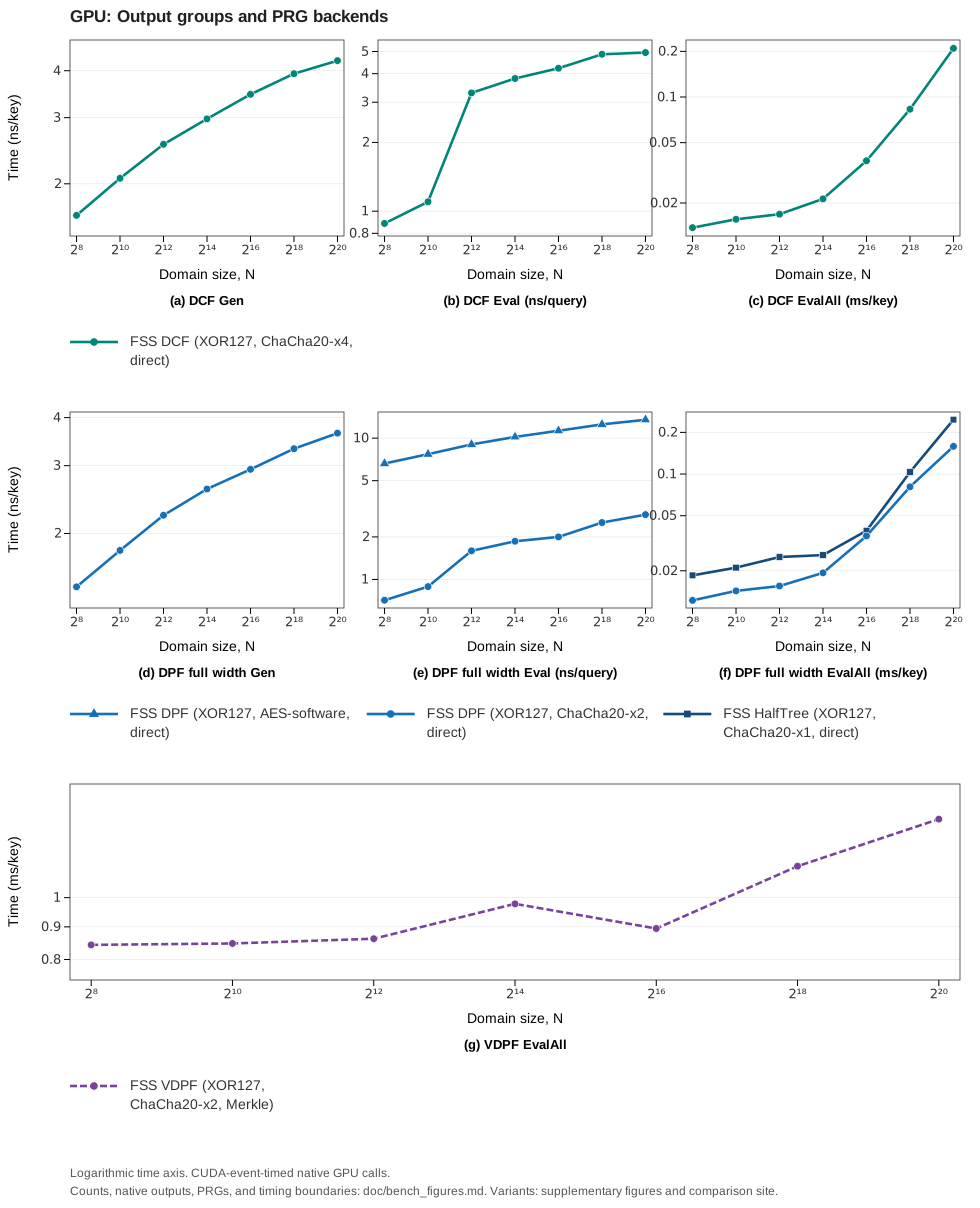
Current-FSS specialty schemes extend these boundaries. Grotto DCF point Eval times the parity-tree query only, with Preprocess outside timing, and its EvalAll times exactly one public EvalAll call, which performs its own preprocessing inside that call. DMPF and VDMPF use t = 64 points with m = ChBucket(64, 80) = 112 Cuckoo buckets and bucket domains of 2^(n-5). DMPF EvalAll evaluates every padded bucket domain, and VDMPF EvalAll materializes through BatchEval over all N inputs, including proof generation, as a point loop. On the GPU, DMPF Eval evaluates a 2^18-point batch per launch through the one-thread-per-point kernel, and EvalAll full-domain-evaluates every bucket key before gathering each domain point's Cuckoo buckets. GPU VDMPF Eval and EvalAll run the same batch pipeline with the Merkle-fold proof included in the timing, while the CPU VDMPF curves time the paper-faithful sequential chains - the accumulator difference follows the per-platform-implementation split below, and proofs do not verify across the two accumulators. CPU VDPF point Eval times Eval plus Prove on the one-element proof sequence. Both CPU Eval and the default EvalAll therefore carry a chain accumulator label. Gen generates key material and has no timed proof accumulator. The metadata records proof_accumulator and proof_generation_included independently of the preserved raw names. The CPU VDPF Merkle/EvalAll row joins the plain chain row with the other accumulator choice: its timed loop produces the Merkle-fold proof, and verification runs outside timing with the accumulator required to match between the two parties (the security doc). VDMPF and VDPF variants carry the accumulator in their names, -chains for the CPU chain rows and -merkle-fold or -merkle for the Merkle-fold rows, so the legends and the comparison site keep the difference visible. The two platforms drive the Cuckoo Locate with their own optimal PRP backend: GPU curves use the device-callable ChaChaFeistel while CPU curves keep the OpenSSL-backed Aes128Feistel, and the figures compare implementations within one platform, never across. The CPU DMPF and VDMPF panels additionally carry AES-NI-rawprp twins of all three operations — the same construction on the intrinsics Aes128FeistelRaw backend — beside the OpenSSL-PRP rows. Packed HalfTree DPF EvalAll emits N/128 packed blocks for one-bit outputs. CPU benchmarks pin one CPU, which also pins the OpenMP team to one thread. DMPF EvalAll would otherwise pay one parallel-region spawn per bucket. The Servan-Schreiber VDPF reference adapter follows upstream test usage: its MMO hash objects are stateful (AES-CTR), so each timed Gen, Eval, or EvalAll re-initializes them inside the timing region, and proof verification is an equality check outside timing.
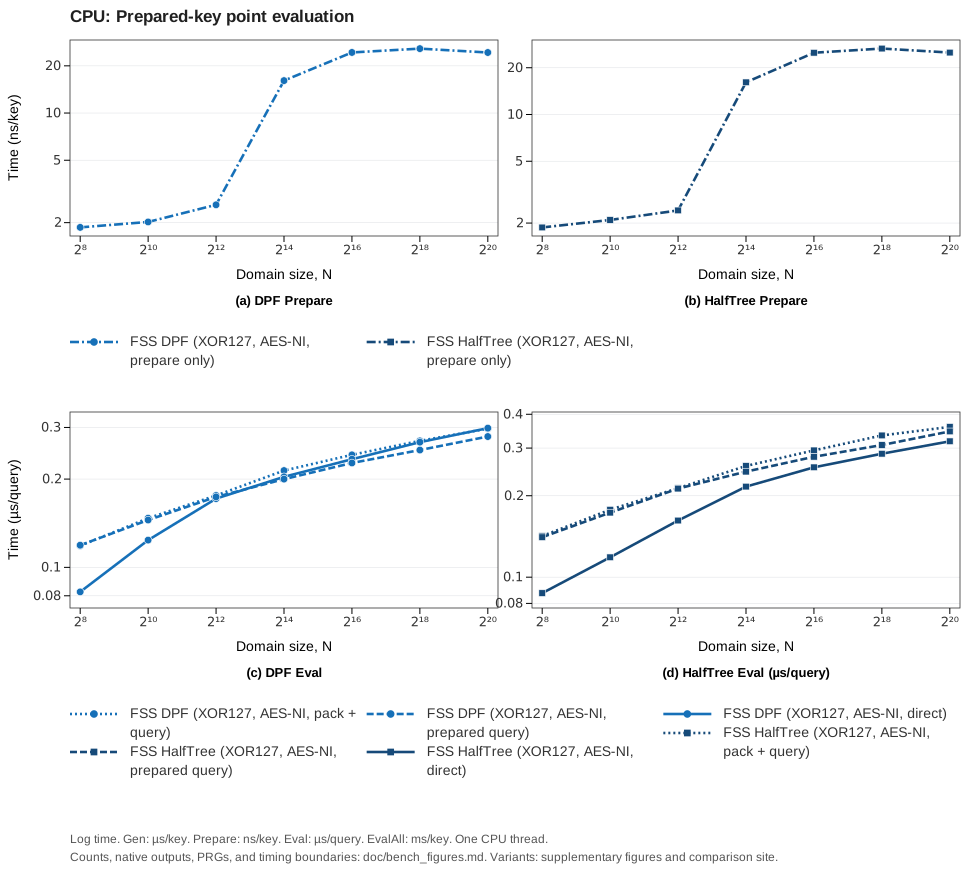
Plain DPF and HalfTree DPF add packed-key preparation and point evaluation rows while their Eval curves stay the unprepared default. PackedKey/Prepare times only packing one key and reports time/key with query_count=0. Key generation and validation are outside timing. PackedKey/Eval packs the key once outside timing and times only prepared-key point evaluations cycling over the domain. PackedKeyOneShot/Eval times the pack plus one point evaluation per iteration, which is the cost without key reuse. The timed loop prevents the compiler from lifting preparation outside the iteration. Both rows check bit-exact agreement with the scheme Eval for both parties outside timing.
Current FSS GPU FullEval sets z = min(17, n) for DPF, z = min(17, n - 1) for HalfTreeDPF, and b1 = z - log2(T). The T sweep therefore adjusts the block root depth to satisfy the public kernel constraint 2^(z - b1) = T. The timed kernel includes all tree traversal and excludes key generation, allocation, and upload.
Google Benchmark runs under the publication profile use five repetitions, at least 0.1 seconds of measurement, and 0.1 seconds of warmup; the decision profile defaults to a 0.3-second minimum measurement, one repetition, and no warmup. The figure uses the median. The current-FSS curves of the 2026-11-08 collection were gathered with an explicit 0.3-second minimum measurement, five repetitions, no warmup, and Google Benchmark random interleaving inside each native command; the figure uses the median of the five repetitions. The repeated FSS samples run with Google Benchmark random interleaving inside each native command; independent binaries and cases are not interleaved. Rust cases use five separate Criterion processes, each with 20 samples, 0.2 seconds of warmup, and a 0.2-second requested measurement interval. The figure uses the median of the five process medians. Criterion can extend an interval for a slow operation. Setup and correctness checks outside the measured iteration do not contribute to operation time.
CPU timings use framework wall time. Current FSS and historical FSS GPU harnesses use CUDA events around operation kernel launches, with allocation and input copies outside timing. The GPU VDMPF rows and the VDPF Merkle EvalAll row instead time the complete public batch call: the API acquires and releases its internal device scratch inside the timed region, while the caller's input and output allocation and upload stay outside it. EzPC Gen/Eval events surround the native GPU API calls and include GPU work and transfers within that interval. EzPC full evaluation times its packed output adapter kernel. GPU-DPF full evaluation places events around the native dpf_hybrid call, with key upload and result download outside timing. These boundaries appear in each record.
GPU-DPF full evaluation uses FUSES_MATMUL=0, one native block, and K=1. It materializes uint128 outputs in native bit-reversed domain order. The checker maps that order to input x outside timing. The EzPC full adapter writes packed bits using the upstream DFS expansion, launches 256 threads, and has one active DFS thread. Label these implementations and their timing boundaries when comparing them with current FSS output materialization.
The renderer and comparison site obtain expected domain coordinates from all measurement statuses and planned run cases. An omitted or failed coordinate breaks each affected curve, including when the entire panel has no successful measurement there. Table cells remain empty. No positive values are interpolated to fill those gaps.
The primary current-FSS CPU curves use AES-NI and the byte group: 127 logical output bits in 128-bit storage. Earlier tables used OpenSSL AES for current FSS CPU operations. That PRG configuration differs, so the new figure values can differ from those tables.
| Implementation | Native output configuration |
|---|---|
| Current FSS and historical FSS 0.7 | 127-bit XOR byte group, 128-bit storage · optional integer group modulo 2^127 |
| Current FSS Grotto DCF | One logical comparison bit · EvalAll returns N bool shares |
| Current FSS packed HalfTree DPF (experimental) | One logical bit · EvalAll returns N/128 packed 128-bit blocks |
| Current FSS VDPF EvalAll | Merkle-fold proof accumulated on device and on the CPU Merkle row · the base CPU VDPF EvalAll row keeps the paper's sequential chain · analysis in the security doc |
| Current FSS DMPF / VDMPF | 127-bit XOR byte group per point · t=64 points over m=112 Cuckoo buckets |
| Servan-Schreiber VDPF (reference) | One logical bit · uint128 shares materialized per point · single point (t=1) |
| Rust FSS 0.6 | 128-bit XOR bytes · optional integer group modulo 2^128 |
| Google DPF / DCF | XOR128 / additive integers modulo 2^128 |
| GPU-DPF CPU and GPU | uint128 scalar output |
| libdpf | One logical bit · Eval returns a packed 128-bit leaf, EvalAll returns N/128 leaves |
| libfss DPF / DCF | GMP scalar modulo nextprime(2^32), a 33-bit field / uint64 modulo 2^64 |
| EzPC full adapter | Packed binary output |
The packed HalfTree GPU wrapper uses ChaCha<1>. Its metadata therefore records ChaCha20-x1 and one output block. Earlier x2 labels are corrected from the wrapper without changing their elapsed measurements.
The legends and records retain native PRGs: current-FSS CPU AES-NI, its GPU ChaCha variants and software-AES point variant, GPU-DPF GPU ChaCha12, EzPC and Google AES128, and historical FSS CPU AES-MMO-NI and GPU Salsa12. libdpf uses AES128-MMO/RustCrypto, with runtime AES-NI dispatch from the pinned aes 0.8.4 crate. libfss uses AES128-MMO/OpenSSL through the low-level AES_encrypt API. The Servan-Schreiber VDPF reference uses OpenSSL EVP AES-128 (ECB for the PRG expansion, CTR for the MMO hash). Output groups, packing, PRGs, and APIs differ across implementations. The experiment reports their native operation times for the configurations listed in each record.
Current FSS GPU EvalAll uses the corrected shared-frontier barriers and depth bounds from commit 5ce7740. The checks cover both party shares and their reconstruction outside timing. Google DCF uses supported additive uint128; the earlier XOR adapter configuration failed reconstruction because the native DCF zero-value conversion does not handle XOR wrappers. Rust FSS 0.6 additive DCF fails equal-alpha reconstruction and stays outside the primary byte-group curves. Preserve that failure if collecting optional integer variants with --include-uint. EzPC's strict DCF API rejects n=8. Historical FSS 0.7 has no native full-domain API. Keep these statuses in the dataset.
The overviews group measured operations by scheme family:
| Family | Overview methods |
|---|---|
| DCF | Default FSS DCF, Grotto DCF, Google DCF, libfss DCF, and measured GPU references |
| DPF full width | Default FSS DPF, HalfTree, Google DPF, libfss DPF, and GPU-DPF |
| Packed DPF | FSS packed HalfTree, libdpf, and an ordinary FSS reference where a packed method was measured |
| VDPF | Default FSS VDPF and measured verifiable references |
| DMPF / VDMPF | Default DMPF and VDMPF with the same point count |
These absolute comparisons retain the slow baselines on log time axes. CPU point operations use µs, GPU point operations use ns, and full-domain operations use ms. The focused setup panels use ns/key. Eval is per query, and the other operations are per key. Single-key batches and independent-key point workloads remain distinct in the records and site configuration. The CPU overview aligns Gen, Eval, and EvalAll by column. The GPU overview places available operations next to each other, without reserving space for missing operations. Missing GPU VDPF Gen/Eval and multi-point Gen measurements remain absent.
Prepared-key variants have a focused default-byte-group comparison with separate setup, steady-state query, and pack-plus-query panels. A speedup panel is produced only for actual paired direct/variant measurements from the same raw receipt with matching configuration. The pairing retains the direct reference receipt. It does not derive standalone setup cost from unrelated medians. The optional integer-group prepared variants were not re-collected; the current comparison site carries the byte-group prepared rows only.
The prepared-key figure, proof-accumulator figure, PRP-backend figure, and GPU output-group and PRG figure retain specialized comparisons. The comparison site retains all measured variants, including historical FSS versions and additional native libraries. build/figures/manifest.json inventories each measured method's static figure and site locations. Supplementary figures are generated only when the required data exist.
The shared description model names direct queries, prepared queries, pack-plus-query operations, standalone preparation, chain/Merkle proofs, OpenSSL/raw PRPs, native output widths/groups, and point counts. Colors identify constructs and dash/marker combinations identify variants. The pipeline checks unique labels and complete styles inside each panel and shared row legend. A shared construction style has one legend entry with operation-specific configuration, such as Gen/Eval output versus packed EvalAll output, or VDPF key generation versus chain point/full-domain proofs. This presentation does not merge measurement records or their sources. Lines do not shift or interpolate missing domain sizes. A broken y axis is not used because the slow and fast curves occupy overlapping time ranges as N changes.
The supplementary block sweep fixes N = 2^20 and varies actual threads per block T: point Eval (including software AES) amortized over K = 262,144 keys, and full-domain EvalAll with K = 1 for the DCF, DPF, HalfTreeDPF, packed, VDPF, and Grotto schemes. The published sweep is the fresh 2026-11-08 to 09 collection for v2.0.0; the earlier 2026-10-18 sweep also carried optional integer-group rows that this collection does not include. Fixed-256-thread DMPF/VDMPF kernels are excluded from this sensitivity sweep. The sweep adjusts the block root depth as described above. VDPF has no T=16 and T=32 points because no tiling satisfies its root-fold constraints at those block sizes, and software AES at T=1024 exceeds the kernel's resource limit and has no timing point. The combined T=1024 EvalAll command aborts at the DCF launch (too many resources requested for launch at the public EvalAllGpu call), and with random repetition interleaving that failure terminates the whole process, so the remaining schemes are collected by scheme-isolated commands at the same settings: DPF, HalfTreeDPF, packed HalfTreeDPF, VDPF, and Grotto DCF all measure successfully at T=1024, and only the DCF launch fails, keeping its failed receipt as the observed variant outcome rather than an extrapolation. The main sweep ran on 2026-11-08 UTC and the isolated supplements on 2026-11-08 to 09 UTC (the DPF supplement on 2026-11-08, the other four on 2026-11-09). The README keeps the domain-size comparison figures. This figure stays in the methodology documentation.
The figure runner shares the profile policy with bench.py through third_party/benchmark_policy.py. The default decision profile requests a 0.3-second minimum measurement, one repetition, and no warmup, and selects only the current FSS wrapper at n = 8 and n = 20 for an ordinary domain sweep. Explicit --libraries, --domain-bits, --platform, --scheme, --operations, and timing arguments override the profile defaults. --profile publication restores the historical sampling and the full library selection used for the published curves, and --profile smoke uses a short correctness budget with full-domain coverage. --plan prints the resolved policy and the exact case list without building; it extends list and --dry-run. New wrapper receipts carry per-iteration work counters with work_schema_version = 1, and a new fss collection whose receipts lack the marker fails instead of falling back to the historical reading; export, merge, and re-read keep accepting historical receipts. The collector accepts the historical key_count/query_count/domain_outputs counters and the new aliases, and keeps logical output counts and packed output bytes separate.
Inspect the requested cases before starting. Each run directory must be new. Use a new suffix for a repeated experiment. The examples below pass --profile publication to reproduce the published curves with the defaults of five repetitions and the measurement settings above.
run exports its chart-data.json and CSV. The default GPU Eval collection uses the same supported-case registry as --scheme, and includes DMPF and VDMPF. Explicit scheme selection skips unsupported operations. Prepare rows are collected alongside the ordinary CPU Eval sweep, keeping the CLI's three ordinary operation defaults unchanged. The current published curves are the 2026-11-08 to 09 UTC collection for v2.0.0: a full CPU domain sweep on cs659b, a full GPU domain sweep on cs11369a whose point-Eval cases come from a second run after a collection-side fix, and a fresh GPU block sweep whose scheme-isolated T=1024 full-domain supplements ran on 2026-11-08 (DPF) and 2026-11-09 UTC (the other four schemes). The merge drops every earlier current-FSS row and keeps the retained third-party rows unchanged as dated historical baselines; export and merge represent one repeated failure configuration as a single record carrying the repetition count in failure_repetitions, while the raw receipts keep every failed repetition. The optional integer output group is not part of this collection: the current-FSS curves cover the byte group, the 63 optional integer-group cells of the earlier current-library CPU sweep are not re-collected, and the native suite still measures the Uint group (bench_cpu). Use export on an individual run to rebuild them from saved case.json files. merge combines completed run exports. For an explicit retry, pass its directory to merge --retry-inputs and retain the superseded attempt provenance. A nonzero exit status can accompany a completed dataset containing recorded failures. Inspect the records and logs before continuing.
Build caches live under build/third_party/sweep/<library>/<platform>. Each result directory contains the run manifest with the declared library versions, per-case configuration and statuses, exact commands, logs, native receipts with the process wall time and exit status, and native JSON or Criterion estimates. Keep these files with the merged data.
Use the offline D3/Playwright setup in the figure authoring guide, then export and inspect build/figures before publishing. Install D3 under build/figure-tools and configure the local Playwright runtime through FSS_FIGURE_NODE_MODULES when the exporter's default runtime path is unavailable. Keep browser downloads under build/figure-tools/browsers as described in that guide:
The exporter writes authoring HTML, SVG, 2x PNG, and a source manifest under build/figures. --publish copies the reviewed SVG and PNG assets to doc/figures, removes previously published figures that the export no longer produces, and writes doc/site/data.json: the trimmed domain-sweep dataset behind the comparison site in doc/site. The site is static and dependency-free. Preview it locally with python3 -m http.server -d doc/site.
1.15.0